What the FAA actually says
Everything here comes from the FAA's "Airline Passengers and Batteries" page, read November 12, 2026. For electric wheelchairs and mobility scooters it lists three situations:
- Lithium-ion battery removed (or not adequately protected): "Lithium-ion battery size is limited to 300 watt hours (Wh). The lithium-ion batteries must be carried in carry-on baggage only. The passenger must advise the airline of the battery location." Lithium metal (non-rechargeable) batteries are forbidden.
- Lithium-ion battery installed and protected by design: "The passenger must advise the airline of the battery location on the device. Mobility device with battery installed and not removed must be checked and not carried on."
- Spillable, non-spillable or dry batteries: "For complete passenger instructions contact your airline as advanced arrangements and extra check-in time may be necessary."
And for spares: "A maximum of one spare battery not exceeding 300 watt hours (Wh) or two spare batteries not exceeding 160 Wh each", carry-on only.
How to work out your battery's watt-hours
The FAA gives the formula: "multiply the volts (V) by the amp hours (Ah)". Its example: a 12-volt battery rated at 8 Ah is 96 Wh. The Wh figure should be printed on a lithium battery; if it is not, do the math and keep the spec sheet with you.
For the lithium scooters we compare:
- Journey So Lite: 24 V × 10 Ah = 240 Wh, stated by the seller, removable.
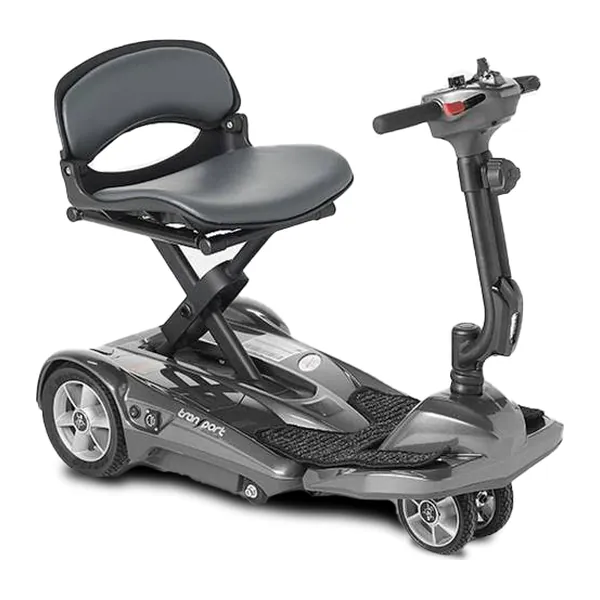
- EV Rider Transport AF+: 25.2 V × 10.05 Ah = about 253 Wh (EV Rider does not print the Wh).
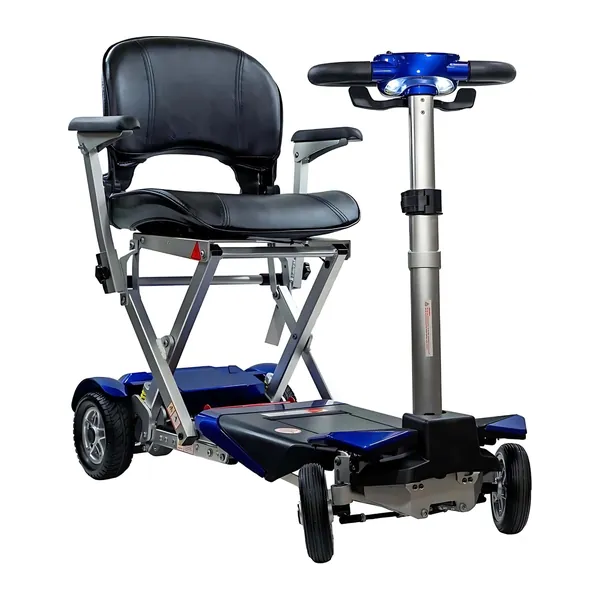
- Solax Transformer 2: 24 V × 10.5 Ah = about 252 Wh.
- Drive ZooMe Auto-Flex: Drive calls its 25.9 V, 10 Ah lithium battery "airline safe"; ask Drive or the seller for the Wh label before you book.
All three computed figures sit under 300 Wh. None of them qualifies as a carry-on spare under the 160 Wh two-battery rule, so one spare at most.
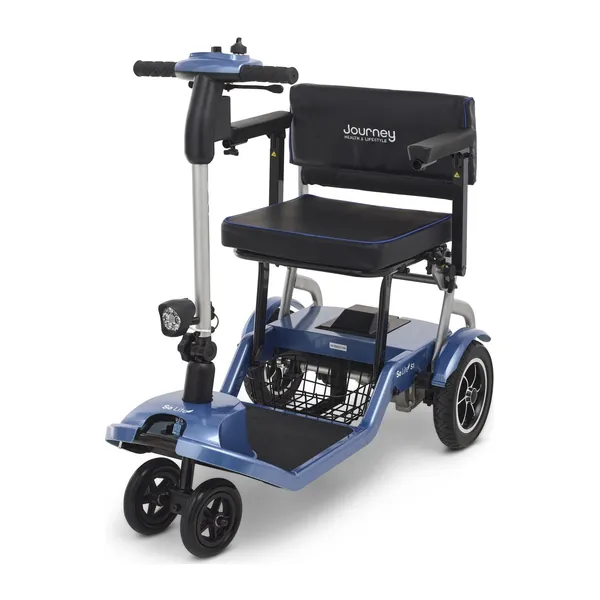
Our No. 1 travel scooter: a one-piece fold at 44.5 lb and a removable 240 Wh lithium battery, under the FAA's 300 Wh limit.
Scooters with sealed lead-acid batteries
Many travel scooters that come apart use sealed batteries. Pride specifies "sealed lead-acid, non-spillable" batteries for the Go Go Elite Traveller 2 Platinum and recommends AGM or gel batteries for the Go Go Sport. Under the FAA table, those fall in the "contact your airline" row: they can fly, but the airline sets the procedure and may need extra time at check-in.
Some makers print bold claims. Vive says its 4-wheel scooter is "TSA approved and safe for air travel"; EV Rider calls the Transport AF+ "fully airline-approved"; Solax calls the Transformer 2's battery an "airline approved lithium-ion battery". The TSA screens passengers and the airline decides on your mobility device, so treat those lines as a starting point and call the airline anyway.
What the travel day looks like
- When you book: tell the airline you are traveling with a mobility scooter, its battery type and Wh, and whether the battery comes out. Ask what they need from you.
- Pack the paperwork: the spec sheet or manual page that shows the battery type and rating. SteadyHome says the So Lite's battery documentation is included in the box.
- At the airport: arrive early. Many riders ride to the gate, then the scooter is tagged and stowed. If the battery is removable lithium, it comes with you in the cabin.
- Protect the controls: fold the tiller, remove the basket, and keep the key with you.
- On arrival: check the scooter for damage before you leave the airport.
The best scooters for flying
For air travel, two things matter most: a battery the airline can deal with quickly, and a scooter staff can lift and stow. That is why our travel ranking weighs the heaviest piece and the air-travel battery at 30% each.
- Journey So Lite ($2,195): the lightest one-piece fold (44.5 lb), removable 240 Wh battery. Rated for 275 lb.
- Drive ZooMe Auto-Flex ($2,824): folds itself by key fob, 300 lb, lithium battery Drive calls airline safe.
- Solax Transformer 2 ($2,775): folds by remote, 13.5 miles of range, about 252 Wh.
- EV Rider Transport AF+ ($2,250): the lightest auto-folder at 49 lb, about 253 Wh, but a 250 lb limit.
A checklist for the airport
Most trouble at the gate comes from missing paperwork, not from the scooter. Before you leave home, put these in the bag you keep with you:
- The battery label or the spec sheet that shows the volts and amp-hours (or the watt-hours). A photo on your phone works, a printout is better when the phone battery is low.
- The owner's manual page on removing the battery, so the ramp crew does not have to guess. Practice taking the battery out at home, twice, until you can do it sitting down.
- Tape and a small bag for loose parts: the basket, the seat cushion and the key travel better with you than under the plane.
- A name tag on the scooter with your phone number and flight.
At check-in, ask the agent to write down whether the scooter comes back to the aircraft door or to baggage claim. If you need it at the door, say so before boarding, not after landing. And check the scooter before you leave the airport: damage reported on the spot is far easier to settle than damage reported from home.
Cruises, trains and road trips
Cruise lines and trains set their own rules for mobility devices, so ask them as you would an airline, and confirm cabin door widths and where the scooter will be stored and charged.
For road trips, the battery rules disappear and the trunk becomes the question. A folding scooter rolls to the car and lifts in one piece; a travel scooter that comes apart lifts in lighter pieces. Our lightweight ranking sorts every scooter by its heaviest piece.
Nothing here is medical advice. Talk to your doctor or physical therapist about whether a scooter suits you, and follow the maker's instructions.
Our three picks for this article
Scores come from our published formula; the full list is in the ranking.