The real difference, in one minute
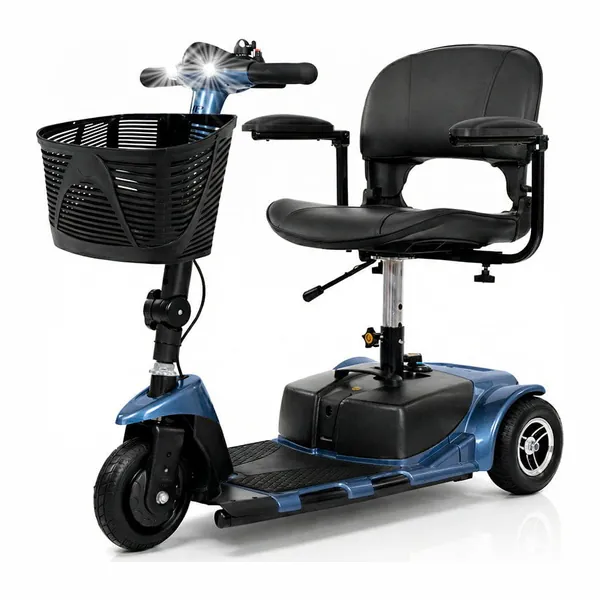
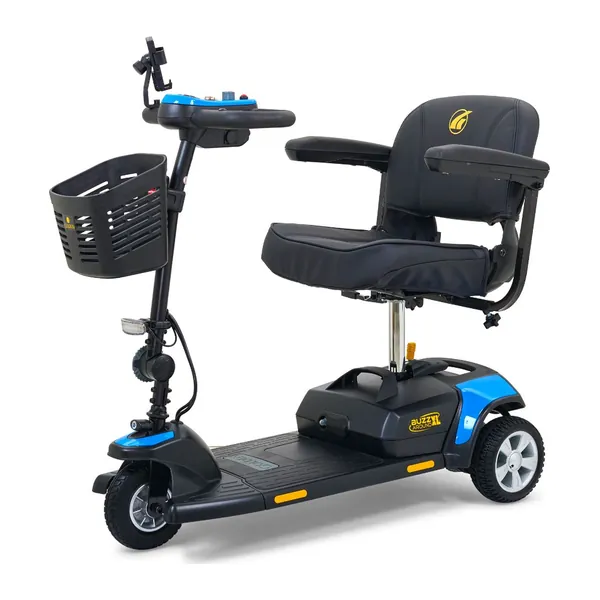
A 3-wheel scooter has one wheel at the front and two at the back. A 4-wheel scooter has two and two. That is the whole design change, and it creates a trade you cannot escape:
- Turning: one front wheel swings further, so a 3-wheeler turns in a smaller circle.
- Legroom: with no second front wheel, the floorboard is narrower at the front and your feet have more room.
- Stability: two front wheels give a wider footprint, so a 4-wheeler is steadier sideways, especially when turning on a slope or crossing a curb cut at an angle.
Makers say the same thing in their own words. Vive's scooter collection page describes its 3-wheel models as "optimized for both indoor and tight space movement" and its 4-wheel models as "optimal for outdoor activities and long-distance travel", under the heading "for Enhanced Stability".
The numbers, on the same scooter
The cleanest comparison is one model sold both ways. Pride's Victory 10 brochure gives the Victory 10 in 3-wheel and 4-wheel versions with the same 400 lb capacity, the same 5.3 mph and the same 15.5 mile range:
| Victory 10 3-wheel | Victory 10 4-wheel | |
|---|---|---|
| Turning radius | 42" | 45.5" |
| Length | 45.25" | 47" |
| Heaviest piece | 54 lb | 63 lb |
| Weight without batteries | 133 lb | 137 lb |
| Price at Mobility Department, Nov 12, 2026 | $2,170 | $2,529 |
So the 3-wheel version is 3.5 inches tighter in a turn, 9 lb lighter at the heaviest piece and $359 cheaper. The 4-wheel gives you the steadier base. At the budget end, Vive's 3-wheel ($624.99) turns in 2.6 feet and its 4-wheel costs $50 more.
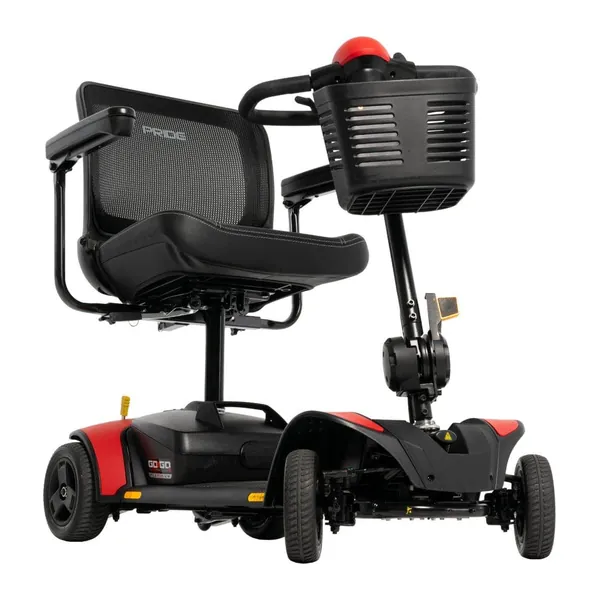
Four wheels that turn like three: a 37-inch turning radius, with Pride's lifetime limited frame warranty, $1,567.
Pick three wheels if
- Most riding happens indoors: an apartment, a small house, assisted living hallways, store aisles.
- The rider is steady sitting up and turning, and does not need the scooter for balance.
- Legroom matters: long legs or a knee that does not bend well.
- Every pound counts at the trunk: on the Victory 10, the 3-wheel's front section is 9 lb lighter.
Three wheels are not "unsafe". They ask a bit more care on slopes and when turning sharply at speed, and they reward a rider who slows down before turning.
Pick four wheels if
- The scooter goes outdoors a lot: cracked sidewalks, driveways, curb cuts, ramps, grass at the park.
- The rider wants the most stable base, or tends to lean when turning.
- You will ride longer distances: Vive pitches its 4-wheelers for "long-distance travel".
- The home has room to turn, or you choose a tight-turning four-wheeler (next section).
If the rider's balance is a real question, ask the doctor or a physical therapist. CMS's own comparison says a scooter needs the rider to keep postural stability while moving; when that is not possible, a power wheelchair is the device it points to.
The middle way: four wheels that turn like three
Makers have narrowed the gap. Pride's EZ Turn gives the Go Go Elite Traveller 2 Platinum a 37-inch turning radius on four wheels; Pride says it offers "3-wheel scooter turning ability and 4-wheel stability". Golden's MicroTurn gives the Buzzaround XL 39 inches, with front and rear suspension. Among the folding scooters, the EV Rider Transport AF+ turns in 31 inches.
Compare that with typical four-wheel travel scooters on our list: 45 inches (Journey So Lite), 47.2 (Drive ZooMe), 52.25 (Go Go Ultra X), 53 (Drive Scout LT). If you want four wheels and tight turns, those two Pride and Golden models are where to start.
Our picks on three wheels and on four
Two pairs on our list show the trade-off with real prices, all checked on November 12, 2026.
The budget pair. Vive sells the same travel scooter both ways. The Vive 3 Wheel was $624.99 and the Vive 4 Wheel $674.99: $50 for the fourth wheel. Both are rated for 265 lb and break down so the heaviest piece is 29 lb. Vive gives the 3-wheel a 31.2-inch turning radius and does not state one for the 4-wheel, so if tight turns are the reason you are shopping, the 3-wheel is the one with a number behind it. The catch on both: 6 months of cover on the electrical parts, batteries and controller.
The brand-name pair. If the budget allows about $1,600, the four-wheel Pride Go Go Elite Traveller 2 Platinum turns in 37 inches, per Pride, which is tighter than many three-wheelers, and it carries Pride's lifetime limited frame warranty with 2 years on the electronics. For most families who are torn between the two layouts, that is the scooter that ends the argument.
Measure before you choose
- Measure the tightest spot the scooter must turn in: usually the hallway into the bathroom or the space between the bed and the dresser.
- Compare it with the turning radius on the spec sheet. If the space is smaller than the radius, plan on a three-point turn there.
- Walk the outdoor route: slopes, curb cuts, the driveway. Lots of slopes favor four wheels.
- Check the heaviest piece if the scooter goes in a car.
Our comparison tool shows turning radius, heaviest piece and capacity for any three scooters.
Nothing here is medical advice. Talk to your doctor or physical therapist about whether a scooter suits you, and follow the maker's instructions.
Our three picks for this article
Scores come from our published formula; the full list is in the ranking.