"All-terrain" is a label, not a spec
Search for an all-terrain mobility scooter and you will find heavy outdoor machines and small folding scooters sold under the same word. Mobility Department, for one, lists an "All Terrain Mobility Scooters" category in its menu, next to its folding scooter collection. There is no test behind the word. So ignore it, and look at five numbers the maker has to publish.
The five numbers that decide where a scooter can go
- Ground clearance. The gap under the lowest part of the frame. It decides whether you scrape on a raised sidewalk slab, a threshold or a root.
- Tires. Pneumatic (air-filled) tires absorb bumps and grip better on grass and gravel, but can puncture. Solid or "flat-free" tires never go flat and ride harder.
- Suspension. Springs or shocks at the wheels. Without it, every crack in the sidewalk goes through the seat.
- Maximum climbing angle. The steepest slope the maker rates the scooter for. Outside it, you are outside what the maker built and tested it for.
- Range. Grass, gravel and hills use more battery than a flat mall floor. EV Rider says it plainly: its figures come from ideal laboratory conditions and real results will differ.
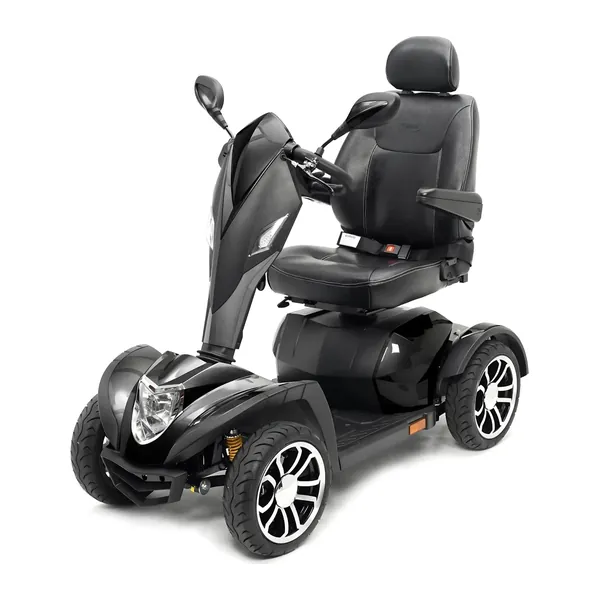
The outdoor machine of our list: full suspension, 14-inch air-filled tires, 7 inches of clearance, 35 miles and 450 lb.
How the 14 scooters we compare stack up
| Scooter | Clearance | Suspension | Tires | Range |
|---|---|---|---|---|
| Drive Cobra GT4 | 7" | Full | 14" pneumatic | 35 mi |
| Journey So Lite | 4" max (mid-frame) | No | 6" / 10" solid | 8 mi |
| Golden Buzzaround XL | 3.5" | Front and rear | Not stated | 8 mi |
| Pride Maxima | 2.25" | No | Not stated | 19.5 mi |
| Pride Victory 10 | 2" | No | 10" solid | 15.5 mi |
| Pride Go Go Sport | 1.5" | No | 9" flat-free | 12 mi |
| Drive ZooMe Auto-Flex | 1.6" | No | 6" / 7" flat-free | 13 mi |
| Vive 4 Wheel | 1.57" | No | Solid | 12 mi |
Clearance, suspension and range from each maker's spec sheet, read November 12, 2026. Climbing angles, where stated: Journey So Lite 8°, Vive 6°, Drive ZooMe 6°, EV Rider Transport AF+ 3°. Pride does not print a climbing angle on the pages we read.
What "outdoor" looks like in real life
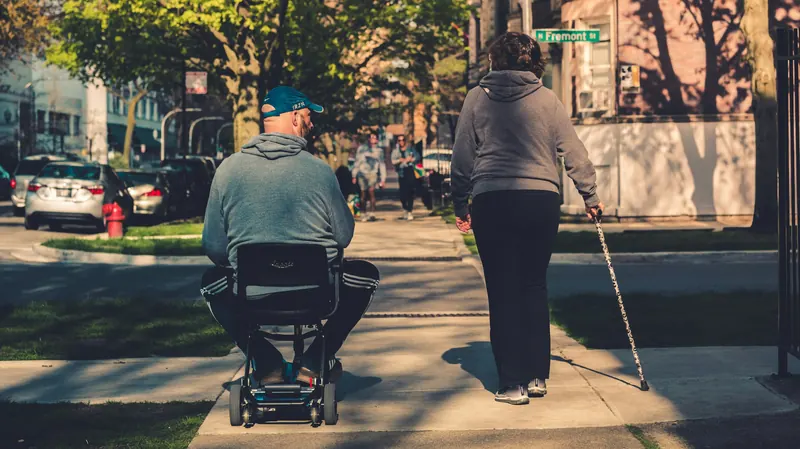
Most riders who search for all-terrain do not want to drive through the woods. They want to get down a gravel driveway, across a park lawn to a picnic table, along a boardwalk, or over the cracked sidewalk outside the house. For that, the difference between 1.5 and 3.5 inches of clearance, and between no suspension and some, matters more than a 10 mph top speed.
- Paved paths, the odd curb cut: a full-size scooter like the Victory 10 (15.5 miles, 400 lb) is plenty.
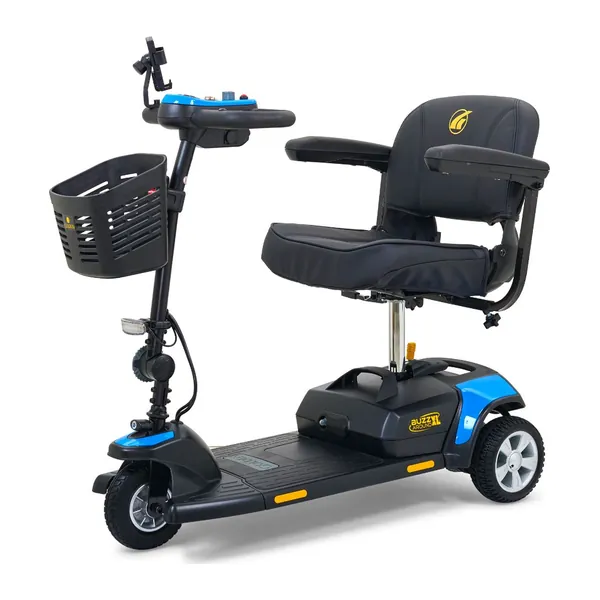
- Bumpy sidewalks and park paths, and you still need a trunk: the Buzzaround XL is the only travel scooter here with front and rear suspension and 3.5 inches of clearance.
- Grass, gravel, long rides, a garage at home: the Cobra GT4.
The trade-off nobody puts in the brochure
Everything that helps a scooter outdoors makes it harder to live with indoors and in the car. The Drive Cobra GT4 is the clearest example on our list: Drive gives it full suspension, 7 inches of ground clearance, a 450 lb rating, 10 mph and up to 35 miles per charge. It also needs an 82-inch turning radius, more than twice the 37 inches of the Elite Traveller 2, and its heaviest piece is a 191 lb base. That is a scooter for a garage, a ramp and a vehicle lift, not for a sedan trunk or a narrow hallway.
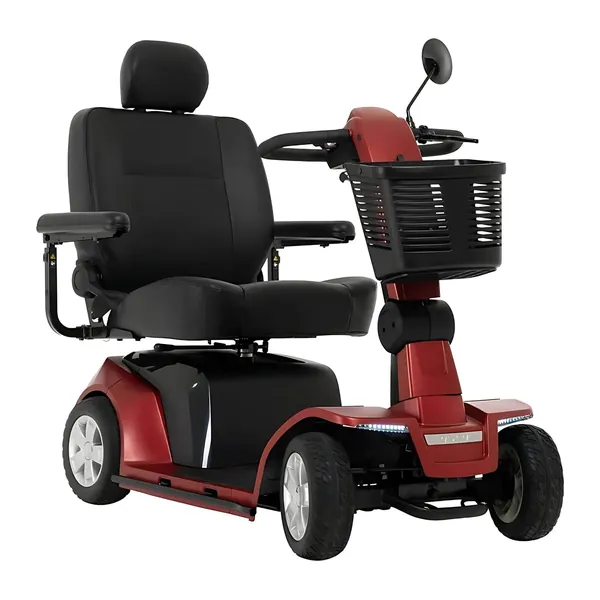
The middle ground is a travel scooter with a little help underneath. The Golden Buzzaround XL has suspension and 3.5 inches of clearance while its heaviest piece stays at 42.5 lb, and the Pride Victory 10 adds range (up to 15.5 miles, per Pride) and a 400 lb rating. If most of the riding is paved paths with the odd lawn, one of those is usually enough.
Stay inside the maker's limits
Every scooter has a rated climbing angle, a weight capacity and conditions the maker warns against in the manual: wet grass, loose gravel, side slopes, curbs taken at an angle. Riding outside them puts the scooter outside what the maker built and tested it for, and it can matter for the warranty too. Read the manual's section on slopes and curbs before the first outdoor ride, and if balance or strength is a question, ask the doctor or a physical therapist what is sensible.
Check local rules as well: where scooters may ride, and at what speed on sidewalks, varies by city and state.
If the rider is heavier
Outdoor riding and higher weight capacity often go together, because the same strong frame and big batteries serve both. On our heavy-duty ranking, the Pride Maxima (500 lb, 19.5 miles, $3,445) and the Victory 10 (400 lb, $2,529) come ahead of the Cobra GT4 on our weights, because they cost less and carry more or similar. The Cobra wins only if speed, suspension and 35 miles of range matter to you.
Nothing here is medical advice. Talk to your doctor or physical therapist about whether a scooter suits you, and follow the maker's instructions.
Our three picks for this article
Scores come from our published formula; the full list is in the ranking.